
Anne Arundel 72 Hour Releases
Anne Arundel County does not publish an official 72-hour release feed. The reviewed detention pages, current inmate locator, and Sheriff app description contain no three-day archive, filter, release cadence, released-person detail view, or post-release retention rule. The county locator is expressly for people committed and currently housed.
A three-day inquiry therefore works as a dated verification file. Record when the person was last seen in current custody, then seek the custody-change event and the detention record. Do not build a list by comparing roster snapshots. Such a comparison cannot distinguish a discharge to the community from a transfer, escape, data mismatch, or another reason a current record is no longer returned.
Check Anne Arundel Three-Day Releases
Build the 72-hour check around the last known county facility. Jennifer Road and Central Holding are tied to intake, pretrial detention, and commissioner review. Ordnance Road holds people serving county sentences and supports supervised alternatives. AACDDF owns those detention records, while a Maryland state prison release belongs to DPSCS.
- Fix the start and end of the three-day period and record the retrieval time for every source.
- Use the county inmate locator to test whether the person is listed in current county custody.
- Search Maryland VINE for the exact record and note any transfer or release event within the period.
- Read Maryland Case Search for bail, disposition, sentence, modification, probation, commitment, or release orders.
- Call AACDDF at 410-222-7374 for public status or discharge information.
- Request the discharge or transfer record through the county PIA portal if written proof is needed.
- Follow any receiving authority instead of labeling a transfer as community release.
For a same-day event with a tighter time focus, use the Jail Releases: 24 Hours workflow.
Anne Arundel 72 Hour Fields
There is no actual county three-day list with published columns. The table below identifies the fields that can support a 72-hour reconstruction and the limits on each one. It keeps current-locator data separate from policy-defined release information, which prevents present custody facts from being misread as a historical discharge record.
| Field | Source | Role in the three-day check |
|---|---|---|
| Name and JID | Current locator or AACDDF record | Matches the right county detention identity. |
| Current location and assigned unit | Current locator | Shows a present listed placement when returned. |
| Court date and case | Locator and Case Search | Points to the legal event but not exact gate time. |
| Detained or released | AACDDF pretrial disclosure | Answers county status for a pretrial person. |
| Manner released | AACDDF pretrial disclosure | Classifies the recorded county release path. |
| Discharge date | AACDDF sentenced disclosure | Places a sentenced county exit within or outside the span. |
| Receiving authority | Discharge or transfer record | Separates community release from continuing custody. |
Actual time of discharge may be requested if maintained and public, but it is not promised as a standard public field. Ask for the narrow event and reasonably segregable public material.
Anne Arundel Weekend Release Timing
The value of a three-day span is practical. A court decision late on Friday may move into facility processing after the court day. AACDDF says court documents generally arrive sometime after 4:00 p.m., and discharge preparation then takes about two to six hours depending on admissions and discharges. A release event may cross midnight even when the court order does not.
Anne Arundel does not publish a weekend or holiday discharge schedule, exit door, family waiting point, or guaranteed release time. The 72-hour frame can contain the likely event without pretending the county publishes a rolling list. Verify the actual date with AACDDF and the authority with the court. Another hold, warrant, identity check, or receiving agency may change the expected result.
Note: A court entry near the start of a weekend is not proof that the person crossed the facility exit at that time.
Anne Arundel Release Data Limits
The current locator accepts a JID or an exact first and last name. Results may show JID, name, sex, birth date, present location and assigned unit, bail, court dates, and District or Circuit Court cases. The interface does not render booking date, charge list, release date, release type, destination, photograph, or historical booking. Those omissions are central to a 72-hour check.
The official locator field definitions make the current-only design visible.
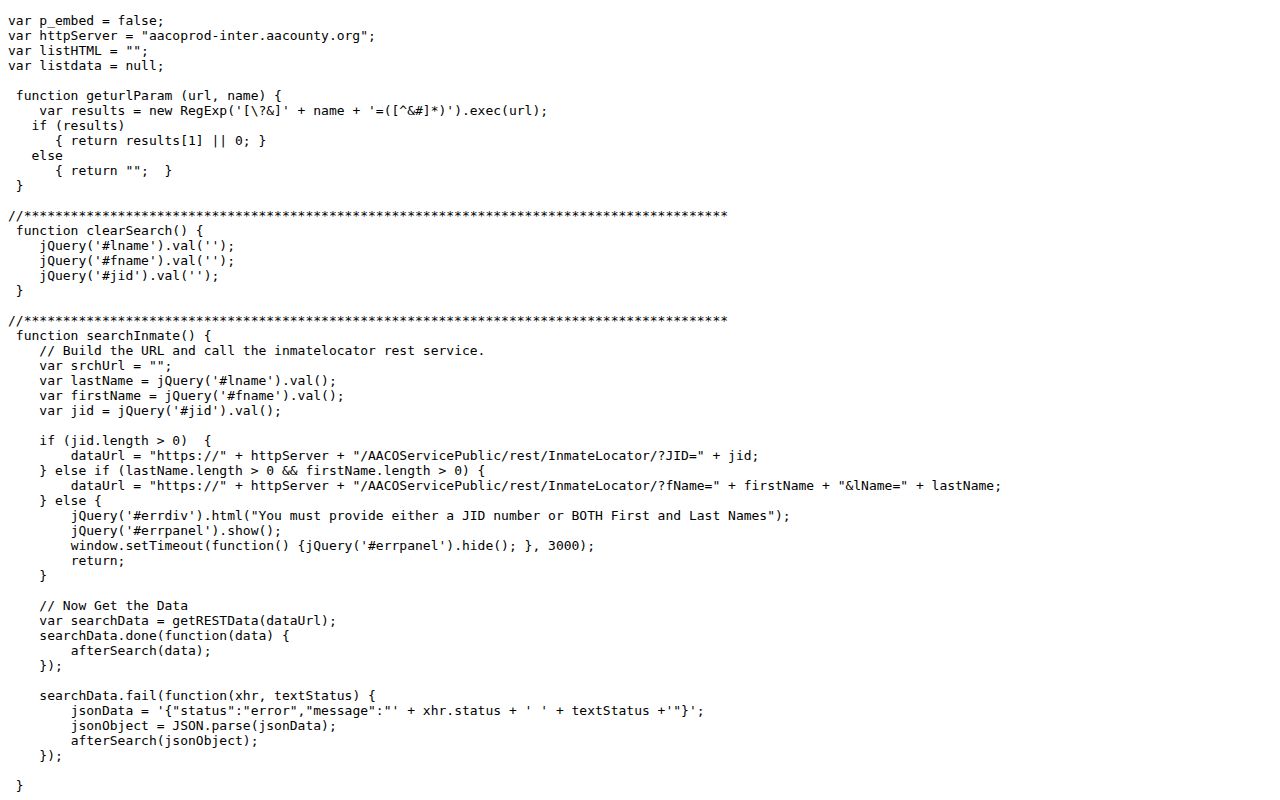
The captured definitions show no released-person row to retain for three days. A change between two live searches remains a lead, not a discharge record.
Anne Arundel Release or Transfer
A community release means physical confinement ended for the community, perhaps under bond, pretrial terms, probation, parole, or mandatory supervision. A sentence-expiration discharge ends the identified custodial sentence but does not rule out another case. A transfer ends one institution’s custody while another facility or authority takes control.
If the county locator is empty but the Maryland DPSCS locator returns the person, the evidence points to county-to-state transfer. If ICE ODLS returns the person after county custody ends, treat the event as an immigration handoff. BOP records answer only federal Bureau of Prisons custody. The county discharge record should identify the manner or receiving authority when that information is maintained and releasable.
| Observed result | Safe conclusion | Next step |
|---|---|---|
| Positive county locator result | Present listed county custody. | Confirm with AACDDF if release processing is expected. |
| County absent, state present | Likely state custody transition. | Follow DPSCS and register for the correct VINE record. |
| County absent, VINE release event | Strong event evidence for that record. | Request AACDDF discharge details and check the court. |
| County absent, no other result | No current match, not proven release. | Call and request the county record. |
Request Anne Arundel Three-Day Records
A focused Public Information Act request can specify the three-day period without asking AACDDF to create a list that does not exist. Give the full booked name, aliases, birth date, JID, facility, approximate admission date, and relevant court case. Ask for the record showing detained-or-released status, manner of release, actual discharge date and time if maintained and public, and the receiving authority if transferred.
Request an electronic copy or inspection, a fee estimate before chargeable work, and reasonably segregable public portions. Maryland law ordinarily requires a prompt grant or denial within 30 days. When production will exceed ten working days, the custodian must provide expected timing, an estimated fee range, and a reason within that ten-day period. The first two hours of search and preparation are generally free under state guidance.
A former inmate’s own institutional-file route is broader but remains subject to exclusions. A third party should not describe the full file as automatically public. Medical, treatment, security, victim, and criminal-history material may be withheld or handled through another process.
Anne Arundel Release Fallback Sources
Maryland VINE can report custody status, location, release date, and events such as release, transfer, or escape for participating Maryland stages. It is event-oriented, not a permanent archive. Re-register when a person moves from county detention to state prison or enters parole or probation. The Sheriff app also documents inmate search and change-of-status notice, but not a 72-hour list.
Maryland Case Search supplies the legal record. Match the defendant, birth date, case number, and court, then review bail, sentence, disposition, probation, and modification entries. A dismissal in one matter does not clear another hold, and a court order is not the same as the exact physical exit. The originating clerk holds the accessible case file when the summary is unclear.
For a Maryland state prisoner, the DPSCS locator only tests present covered custody and excludes anyone no longer in custody. Seek the state commitment and release record for history. For ICE, the 60-day post-release window belongs only to immigration custody. BOP’s historical result belongs only to federal custody. Neither source may be repackaged as Anne Arundel County 72-hour release data.
Keep a short evidence log for the three-day span. Note the source, the retrieval date and time, the identifiers used, the exact status wording, and any stated event date. A court release order plus a continuing county match may reflect processing or another hold. A county no-result plus a VINE transfer should be followed to the receiving record. Preserving the disagreement gives AACDDF enough context to resolve it and avoids turning an uncertain sequence into a false release claim.
The same care applies when a person appears under more than one county location. Central Holding handles arrest processing and commissioner review, while Jennifer Road receives a person who remains detained. Ordnance Road arrivals pass through Jennifer Road receiving. Those internal steps can create several place references inside the three-day span, but only the discharge or transfer event answers how county custody ended.