
Anne Arundel Projected Release Dates
A projected date is a working calculation. It may combine the sentence start, credit for time already served, the structure of concurrent or consecutive terms, expected diminution credits, and the rules tied to the offense. An actual release date records when confinement ended. Between those points, discipline, a new order, a detainer, recalculation, or a parole decision can change the path.
Pretrial custody is different. A person held at Jennifer Road Detention Center may be released after bail, recognizance, supervised pretrial release, dismissal, or another court order. There is no sentence-end date to calculate before conviction and sentencing. Even after a release order, AACDDF must receive and process the paperwork, check identity and warrants, and resolve other holds.
- Projected date
- A date calculated from the current sentence and credit data that may still change.
- Parole eligibility
- The point when parole may be considered, not a promise of release.
- Maximum expiration
- The end of the full sentence term, subject to the controlling record.
- Detainer
- A request by another authority that can cause a hold or transfer.
No Anne Arundel Release Date Field
The Anne Arundel inmate locator is for people committed and currently housed. Its details can show current location, housing, bail, court dates, and court cases. It does not render a projected date, actual release date, release reason, or historical booking. Once a released person drops out, the locator cannot answer when that person left.
The DPSCS Incarcerated Individual Locator also lacks a general projected or tentative release-date field. It expressly excludes people no longer in custody, including those released or escaped. Therefore, a no-result is not a completed date calculation. It can also reflect a search mismatch, an omission within the locator's coverage, or movement outside the displayed population.
The successful source capture documents the state locator's current-custody rule.
Read the DPSCS locator scope before using a result.
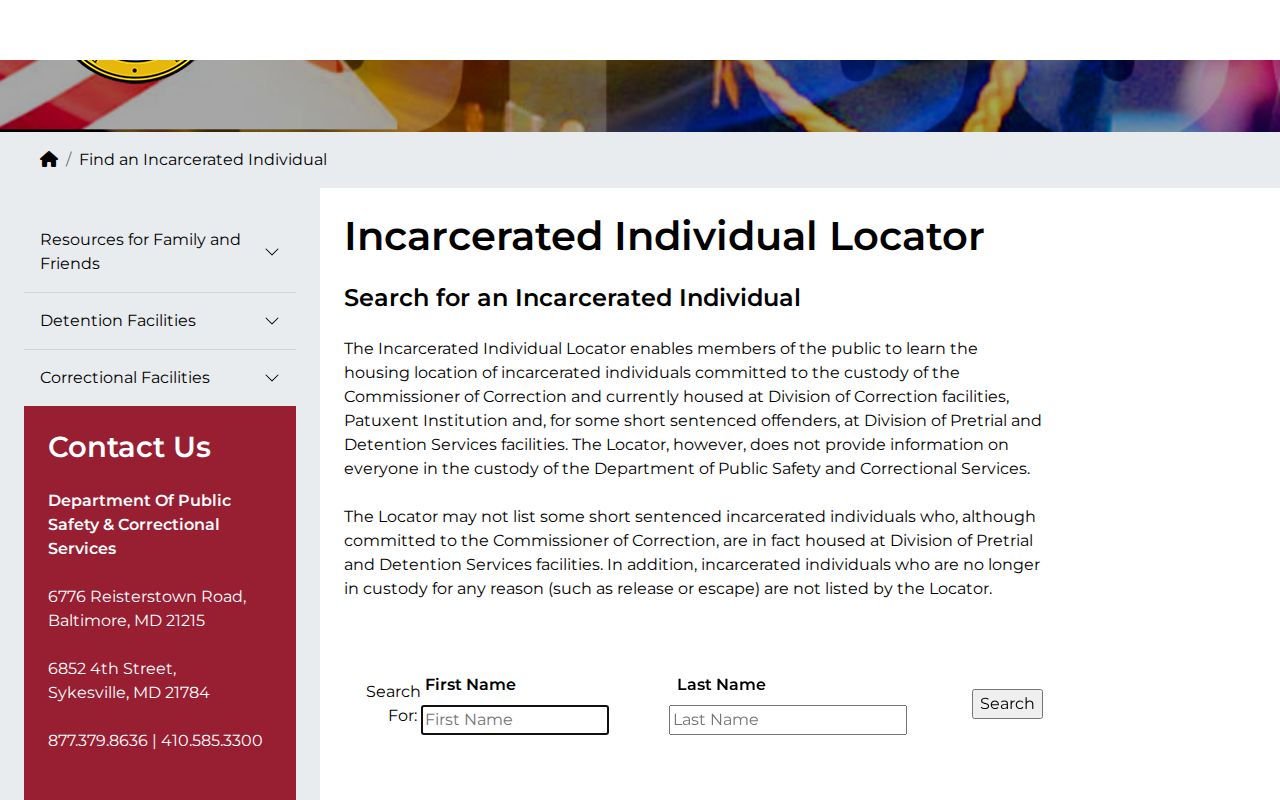
This current-only scope is why a commitment and credit record, rather than the search screen, is needed for a reliable calculation.
Find Anne Arundel Projected Release
First identify the authority holding the person. AACDDF keeps Jennifer Road and Ordnance Road records. DPSCS keeps Maryland prison records. The court controls the sentence and later modifications. Mixing those sources can produce a date from the wrong term or facility.
- Confirm whether the person is pretrial, serving an Anne Arundel County sentence, or in Maryland state prison.
- Read the court case for commitment, sentence length, credit for time served, modification, and other release-related orders.
- For a county sentence, ask AACDDF for the commitment record, discharge information, and any releasable credit calculation.
- For state custody, request the DPSCS commitment and release record, maximum expiration, mandatory-supervision date, and diminution-credit calculation.
- Check whether another case, detainer, appeal, disciplinary action, or transfer changes the apparent date.
- Use VINE for an event alert, then confirm the actual release with the custodian.
A focused DPSCS request can go through the state Public Information Act page. The state form lists copy and certification charges and gives the first two hours of search and preparation without charge. County records require the county process. DPSCS expressly says local detention-center files are not state records.
A former state prisoner seeking their own base or medical file, or an authorized representative, should use the institution-of-release or Case Management Office for Operations route. That office can be reached at 410-585-3300. A third-party public request should stay focused on commitment and release facts. Protected medical, treatment, security, and personal data may be withheld or redacted, while reasonably segregable public portions can still be requested.
Note: Ask for the credit worksheet instead of using a simple online sentence calculator that cannot see the full commitment record.
Maryland Credits Shape Anne Arundel Release
Maryland Correctional Services §3-704 ordinarily awards ten days of good-conduct credit for each calendar month, prorated for partial months. A term that includes specified violent or serious drug offenses receives five days per month under the statutory rule. Credit does not accrue for periods that do not count as sentence service, including a stay, escape, or certain time after revocation.
Other statutes add distinct credit types. Section 3-705 permits work credit. Section 3-706 covers satisfactory progress or completion in qualifying education, job training, treatment, life-skills, and other programs. Section 3-707 addresses special-project credit, and §3-708 caps total monthly credit. Credits can be revoked for discipline and may be restored under governing rules. The record must show which credits were actually awarded.
The successful statute capture shows Maryland's ten-day and five-day good-conduct rules.
Read Correctional Services §3-704 in the official Maryland code.
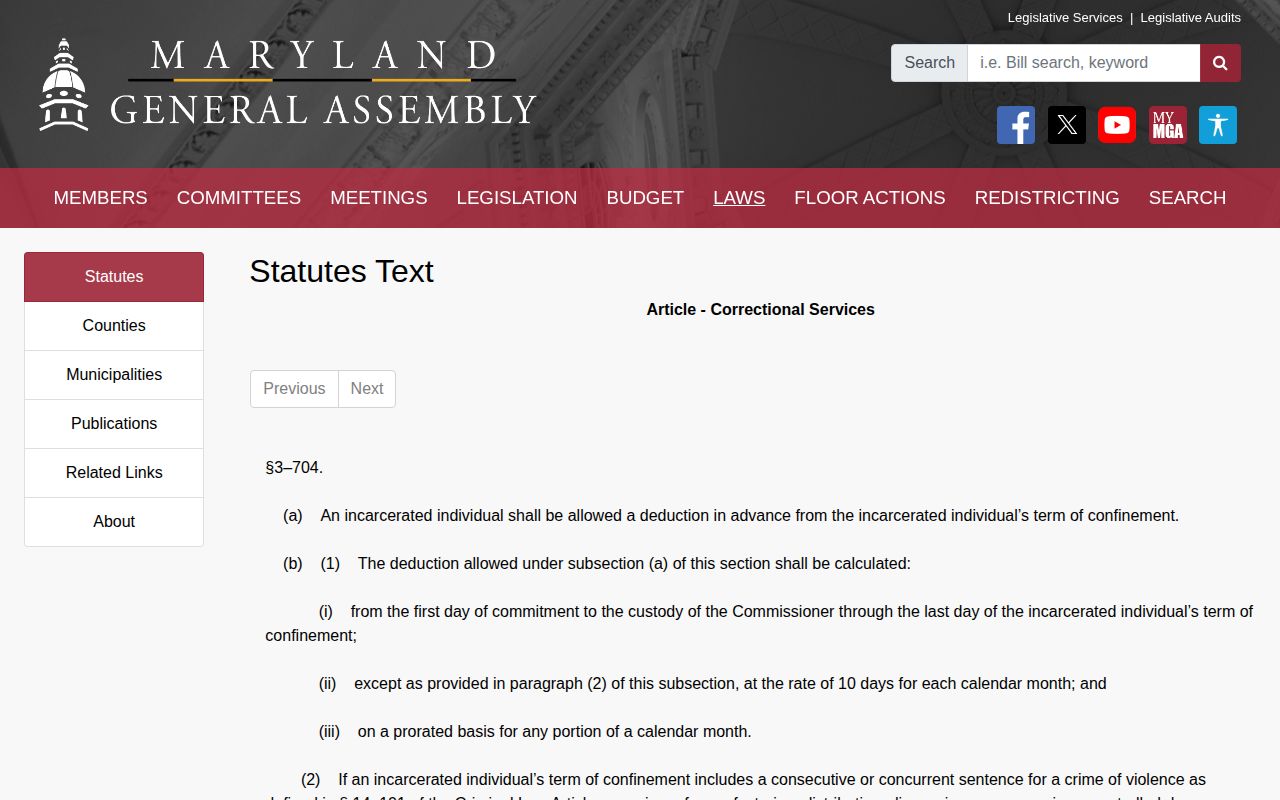
The statute defines the rate, but the person's sentence and institutional record determine the actual projected release calculation.
Under Correctional Services §7-501, diminution credits can lead to conditional release before the full term expires. DPSCS explains that credits reduce confinement rather than erase the sentence. The unserved balance is completed under mandatory supervision, which uses parole-like conditions.
Anne Arundel County Sentence Credits
AACDDF states that sentenced people serve court-ordered time minus “Good Time.” The county Weekender Program publishes five days of good-conduct time for each thirty days served, prorated. Other county program rules may affect a particular record. Ordnance Road Correctional Center also supports work release and house arrest, but those statuses are not the same as a completed sentence discharge.
County calculation depends on the commitment, prior jail credit, concurrent or consecutive terms, offense category, discipline, program eligibility, detainers, and later orders. The Anne Arundel court file should be reconciled with the AACDDF record. A court order supplies legal authority; the facility record is stronger for the actual date and time that county physical custody ended.
For a pretrial person, the most useful court fields are bail, release conditions, hearing entries, and an order resolving custody. For a sentenced person, look for the term, credit for time served, modifications, probation, and violation entries. Maryland's online court portal is a summary. The originating clerk maintains the full file, and an Anne Arundel District Court case may follow a different record path from a Circuit Court felony or jury matter.
If release paperwork arrives from court, the AACDDF FAQ says it generally reaches detention after the court day and facility processing can then take roughly two to six hours. That interval is an operational estimate, not a promised projected release time. Admissions, discharges, identity checks, warrants, and holds can alter it.
Parole Eligibility Is Not Release
Maryland does not impose one blanket “serve 85 percent” rule in the governing provisions reviewed for this project. Under Correctional Services §7-301, the usual parole threshold is one-quarter of an aggregate sentence of at least six months. For a violent crime committed on or after October 1, 1994, eligibility is generally the greater of one-half of the aggregate violent sentence or one-quarter of the total aggregate sentence. Other offense and life-sentence rules can differ.
Eligibility opens a decision process. It does not set the release date. The Maryland Parole Commission may approve, rehear, or deny a case. An approval can still depend on an acceptable home plan and prerelease steps. For a defined administrative-release group, §7-301.1 uses the phrase “tentative release eligibility date,” but that is not a public locator field or a date for every prisoner.
Mandatory supervision is also distinct from parole eligibility. Diminution credits can advance release from confinement, but the balance of the sentence continues under supervision. Maximum expiration, mandatory-supervision release, parole eligibility, and actual discharge should appear as separate requested fields when the state record can lawfully provide them. Treating them as one date hides the legal status that follows the gate event.
The Anne Arundel County probation and parole page explains how to verify the responsible supervision route after release. DPP status can corroborate community supervision, while the facility record confirms the confinement exit.
Anne Arundel Release Date Changes
A calculated date is only as current as its source data. The table below separates common change factors from the record that can verify them. No single public screen exposes all of these inputs.
| Factor | Possible effect | Best confirmation |
|---|---|---|
| Credit award or restoration | Can advance conditional release. | Current institutional credit worksheet. |
| Disciplinary credit loss | Can move the calculated date later. | Institutional credit and disciplinary record. |
| Court modification or appeal | Can alter the term or authority. | Originating court order and amended commitment. |
| Detainer or another case | Can cause continued custody or transfer. | Facility record and receiving authority. |
| Parole action | Can authorize conditional release or set a later review. | Parole Commission decision plus actual release record. |
| Administrative recalculation | Can correct a prior date in either direction. | DPSCS or AACDDF calculation record. |
For Maryland Correctional Institution–Jessup, an institution change during the announced closure process may be a transfer rather than release. A new facility assignment should be checked through the statewide custody and records channels before anyone states that the person entered the community.
Confirm Anne Arundel Actual Release
Registering for a Maryland VINE notice is useful once the correct county or state record is identified. Registration may need to be renewed after a transfer. The alert confirms that the tracked record changed, but a handoff to another authority can still look like release from the first custodian. Read the event wording and follow the receiving record.
For county confinement, ask AACDDF for detained/released status, manner of release for a pretrial person, or a discharge date for a sentenced person. For state confinement, request the DPSCS commitment and release record. Compare the court order, VINE event, and facility record. When the dates disagree, retain the mismatch and ask the offices to reconcile it.
Save the name, JID or DOC number, case number, facility, source, and retrieval date. Those details prevent a date from one person or one sentence from being applied to another. If a transfer is reported, identify the receiving authority and continue there. A move from county detention to a Maryland prison ends the local stay but does not create a community release date.
Note: A projected date can guide a later check, but only the actual discharge record proves when physical custody ended.