
Anne Arundel Parole and Probation
A person can leave Anne Arundel County detention and still face a formal set of community rules. The source of those rules matters. The Maryland Parole Commission may authorize parole from a Maryland sentence, while the Division of Parole and Probation, or DPP, performs community supervision. A judge orders probation. Mandatory supervision begins when state sentence credits advance release before maximum expiration. County pretrial supervision comes from a bail or release order and is administered through Anne Arundel detention programs. It is not parole or probation.
The Anne Arundel County release record answers when county confinement ended. It does not by itself prove which office now supervises the person. Likewise, a DPP status can support that someone is in the community, but it may not show the exact gate time at Jennifer Road Detention Center or Ordnance Road Correctional Center. Match the release record, court order, and supervision source instead of forcing one system to answer every question.
| Status | Who creates it | What it means |
|---|---|---|
| Parole | Maryland Parole Commission | Conditional release before sentence expiration, followed by DPP supervision. |
| Probation | Maryland court | A community sentence or a term that follows confinement. |
| Mandatory supervision | Maryland law and DPSCS calculation | Release after diminution credits, with the balance served under parole-like rules. |
| Pretrial supervision | Court and AACDDF | Conditional community status while a case is still pending. |
- Discharge
- The formal end of confinement or supervision, depending on the record.
- Absconder
- A supervised person alleged to have stopped reporting or left supervision without permission.
- Detainer
- A request by another authority to hold or transfer a person.
Verify Anne Arundel Post-Release Supervision
Maryland has no general public, name-searchable DPP roster. Verification therefore works as a chain. Start with the record that created the status. A court docket can show probation, a violation, or a sentence. Maryland VINE can report participating probation and parole changes. The Parole Commission can address its public decisions, while DPP can identify what public information the responsible office may provide. Protected services for registered victims must not be treated as open disclosure to every caller.
- Search the Maryland court case by name or case number. Match the date of birth and the Anne Arundel court before reading probation or violation entries.
- Check the correct Maryland VINE record for a custody or supervision change. Re-register when the case moves from county detention to state prison, probation, or parole.
- Decide whether the source points to parole, probation, mandatory supervision, or pretrial release. Those labels identify different agencies and records.
- Call the geographically relevant DPP field office with enough identifiers. Ask which office is responsible and what public status can be confirmed.
- For a parole decision, contact the Maryland Parole Commission or request the public record. An approval does not prove that physical release has occurred.
The full Anne Arundel County search and discharge-record path appears on the released-inmates home page. It helps distinguish a true community release from a transfer to state, federal, immigration, or another local authority.
Anne Arundel Supervision Field Offices
Anne Arundel County is served by two DPP field offices, and both are also labeled DDMP in the state directory. Location can guide the first call, but it should not be used to guess a person's agent or status. Ask which office owns the case. The official DPP office directory is the source for current office details.
Annapolis Field Office / DDMP
251 Rowe Boulevard, Ground Floor
Annapolis, MD 21401
410-260-1900 or 410-260-1930
Fax: 410-260-1942
Glen Burnie Field Office / DDMP
District Court Multi-Service Center
7500 Ritchie Highway, Room 109
Glen Burnie, MD 21061
410-412-7050 or 410-412-7040
Fax: 410-508-2387
The state directory shows the Anne Arundel County offices in the source view below.
Review the DPP office listing before calling.
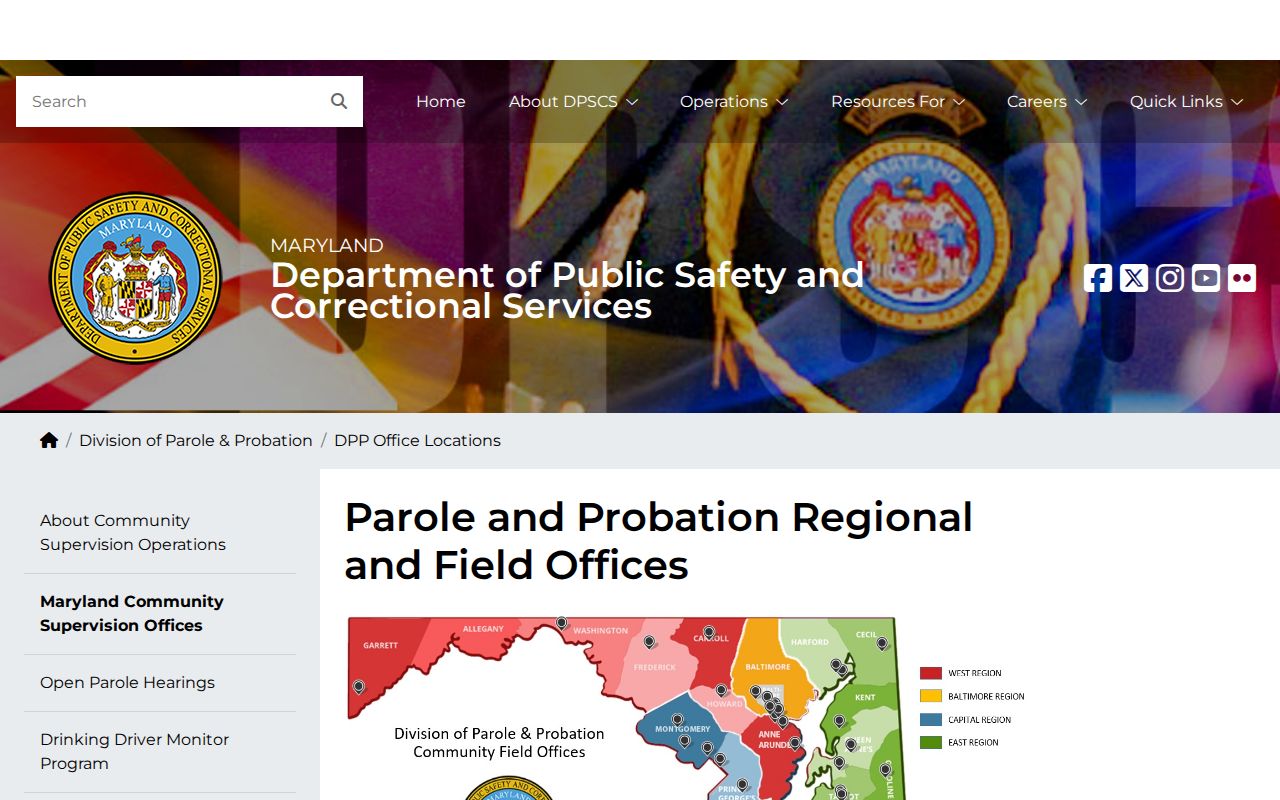
The two rows support local routing, but they do not create a public Anne Arundel County supervision search by person name.
When neither office is clearly tied to the case, DPP headquarters can be reached at 410-585-3500 or dpp.inquiries@maryland.gov. Do not send sensitive data that the office has not asked for.
Anne Arundel Supervision Warrants
A supervision violation is an alleged breach of a court or release condition. It can lead to a report, hearing, warrant, arrest, modification, or revocation, but the result depends on the governing order. An absconder is generally someone alleged to have stopped reporting or left supervision without approval. Maryland does not publish a statewide public DPP absconder list. A missing public record should not be treated as proof that no violation exists.
The Anne Arundel Sheriff's active-warrant information may disclose a county court warrant. It is not a parole-absconder database, and a warrant does not establish current custody. Read the underlying court case when public, then confirm the responsible office. DPP lists 877-227-8031 and its inquiry email for nonemergency supervision concerns. Immediate danger belongs with emergency services.
Conditions are set by the controlling court, Commission decision, or release document. They may govern reporting, travel, treatment, contact, testing, or other conduct, but no condition should be assumed from the status label alone. A probation docket entry can identify the court action, while the full order may contain terms that the online summary omits. For parole or mandatory supervision, ask for the available Commission or DPSCS record and follow DPP instructions. If a violation is alleged, the later warrant, hearing, or revocation record shows what the agency or court actually decided.
Note: A supervision warrant, a county booking, and a Maryland prison return can appear in different systems and at different times.
Anne Arundel Parole Release Decisions
The Maryland Parole Commission publishes an open-hearing master list and public meeting material. The hearing list can show a date, time, location, name, and DOC or CL number. It does not include every hearing and does not serve as a decisions database. The Commission's public governance meetings are also not the same as a person-specific parole hearing.
A parole outcome may approve release, set a rehearing, or deny release. Approval can still depend on a suitable home plan and other prerelease steps. A rehearing means the matter will be considered later; it is neither a release nor always a final denial. Contact the Commission at 410-585-3200 for available public decision or vote information, or use the DPSCS Public Information Act process. VINE and the eventual discharge record remain key evidence of the actual change in custody.
Anne Arundel Release Reentry Support
Anne Arundel County operates a named Re-Entry & Community Collaboration program for county residents who were formerly incarcerated or otherwise involved with the justice system. Its navigation can address treatment, transportation help, mentoring, legal assistance, life skills, family services, and replacement identity documents. The program can be reached at 410-222-3381 or P94067@aacounty.org.
This service is separate from DPP supervision. Participation does not prove parole, probation, or discharge, and the published daily transportation applies to travel from a central point to a training site. It is not a promised ride from a detention-facility gate. Use the service for support navigation while using court, VINE, DPP, and facility records to verify status.
Anne Arundel Release Property Records
Release also creates practical records. Ordnance Road Correctional Center states that personal property is inventoried and stored at intake, while institutional clothing and linens must be returned at release. A person who sees an error in AACDDF institutional data may ask in writing to correct non-criminal-history information. Criminal-history and court errors follow separate CJIS or court routes.
The county reentry program can help a resident navigate replacement identification. That can matter when returning home or reporting to the supervising office, but it does not alter the legal supervision record. Keep the property receipt, release papers, court order, and DPP instructions separate. Each document answers a different question and may have a different correction process.
Note: A former inmate's own file request remains subject to exclusions, and a third party is not entitled to the whole institutional file.
Anne Arundel Supervision Discharge
Supervision ends through a formal discharge, expiration, or other agency or court action. A jail discharge is not the same event. Someone can leave Jennifer Road Detention Center and begin probation that day, leave state prison on mandatory supervision, or complete confinement yet remain under parole conditions. Maximum expiration usually means the sentence has reached its full end, while an earlier credit-based release leaves a balance under mandatory supervision.
Ask for the record that matches the question. The court file is central for probation. The Parole Commission record addresses parole authority. DPP maintains the community-supervision record. AACDDF or DPSCS supplies the confinement release record. When dates conflict, preserve that conflict and ask the originating offices to reconcile it rather than choosing the newest screen.
Maryland VINE can provide a further event check, but it is not a permanent supervision archive. Registration may need to be renewed when the case moves from prison to parole or from a court stage to probation. A VINE change, a DPP confirmation, and a formal discharge order answer related but distinct questions. Record the source and retrieval date for each one. That makes it possible to tell whether the evidence describes release from confinement, an active Anne Arundel County supervision term, or the final end of supervision.